
Your first step to reading Japanese
You’ve heard “arigatou” and “sugoi” a hundred times in anime. Now imagine seeing ありがとう and すごい on screen and reading them yourself.
That starts with hiragana: 46 characters, and most learners can read all of them in about a week.
In this guide, you’ll get:
- A clear hiragana chart with romaji
- The few sounds that don’t follow the pattern
- Stroke order tips for the characters people get wrong
- Look-alike pairs and how to tell them apart
- A simple 7-day plan
- A free printable workbook to practice with
I’m Aisha sensei. I’ve taught Japanese since 2017, and this guide gives you everything you need to get started.
What is hiragana?
Hiragana is one of the three Japanese writing systems, along with katakana and kanji. Each hiragana character stands for one sound, like か (ka) or す (su).
You’ll see it everywhere:
- Grammar parts, like the は in こんにちは
- Words that are usually written without kanji, like ありがとう
- Small reading guides above kanji, called furigana
Furigana is great news for anime and manga fans. Many manga for younger readers print it above every kanji, so once you know hiragana, you can start reading real pages.
That’s why every Japanese learner starts here.
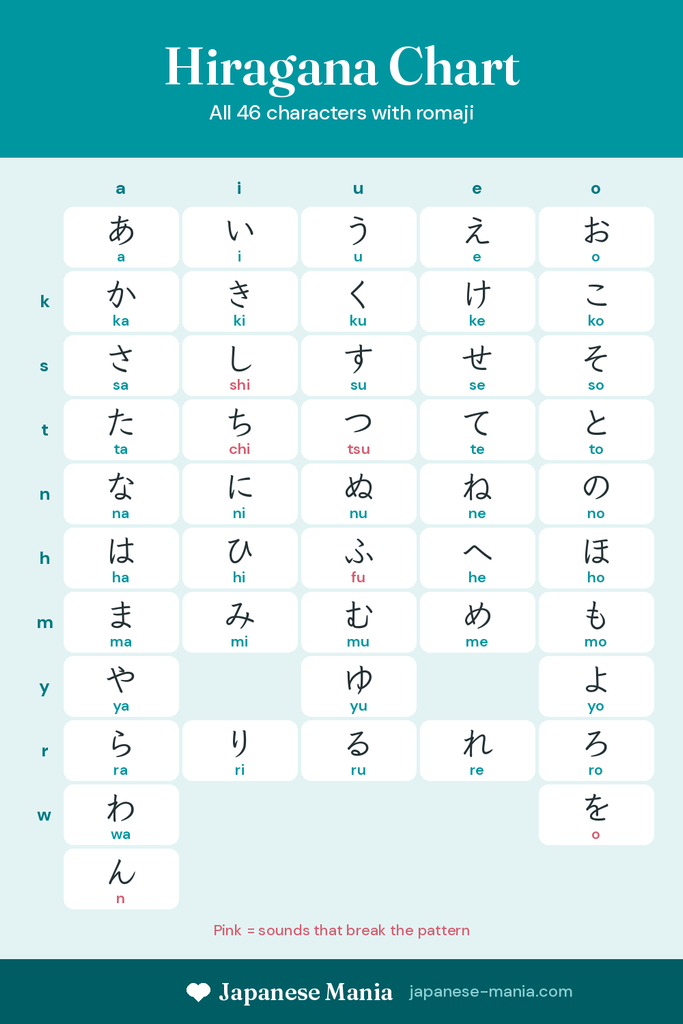
The hiragana chart (all 46 characters)
| a | i | u | e | o | |
|---|---|---|---|---|---|
| – | あ a | い i | う u | え e | お o |
| k | か ka | き ki | く ku | け ke | こ ko |
| s | さ sa | し shi | す su | せ se | そ so |
| t | た ta | ち chi | つ tsu | て te | と to |
| n | な na | に ni | ぬ nu | ね ne | の no |
| h | は ha | ひ hi | ふ fu | へ he | ほ ho |
| m | ま ma | み mi | む mu | め me | も mo |
| y | や ya | ゆ yu | よ yo | ||
| r | ら ra | り ri | る ru | れ re | ろ ro |
| w | わ wa | を o (wo) | |||
| n | ん n |
How to read the chart: Japanese has only five vowels: a, i, u, e, o. Each row adds one consonant to those vowels. So the k row is ka, ki, ku, ke, ko.
Learn the five vowels and the row order, and the whole chart starts to make sense. Japanese dictionaries use this same order.
6 sounds that break the pattern
Most of the chart is regular, but watch out for these:
| Character | You might expect | Actual sound |
|---|---|---|
| し | si | shi |
| ち | ti | chi |
| つ | tu | tsu |
| ふ | hu | fu (soft, between “f” and “h”) |
| を | wo | o (used only as a grammar particle) |
| ん | – | n (the only character with no vowel) |
Bonus tip: は and へ change sound when they’re used as grammar particles. は becomes “wa” and へ becomes “e.” That’s why こんにちは is read “konnichiwa.”
Two small marks that add 25 more sounds
Once you know the 46 basic characters, two small marks give you 25 more sounds for free.
- Dakuten (゛), two short lines, makes the sound “heavier”: か (ka) → が (ga)
- Handakuten (゜), a small circle, is used only on the h row: は (ha) → ぱ (pa)
| Row | With the mark |
|---|---|
| k → g | が ga ぎ gi ぐ gu げ ge ご go |
| s → z | ざ za じ ji ず zu ぜ ze ぞ zo |
| t → d | だ da ぢ ji づ zu で de ど do |
| h → b | ば ba び bi ぶ bu べ be ぼ bo |
| h → p | ぱ pa ぴ pi ぷ pu ぺ pe ぽ po |
ぢ and づ sound the same as じ and ず, and they’re rarely used. Focus on the others first.
Stroke order: 3 rules and 5 tricky characters
Stroke order matters more than it seems. It makes your writing look natural, and it helps you read handwritten Japanese later.
Three basic rules cover most characters:
- Top to bottom
- Left to right
- Horizontal lines usually come before the lines that cross them
These five characters are where beginners make the most mistakes:
- あ (3 strokes): First the short horizontal line, then the long vertical line, then the big loop.
- き (4 strokes) and さ (3 strokes): In many computer fonts, the bottom part looks connected. When you write by hand, it’s a separate stroke.
- ふ (4 strokes): Write it top, middle, left dot, right dot. Don’t try to connect it into one shape.
- を (3 strokes): The first stroke is a short line, and the last one is a big curve that sweeps across.
- そ (1 or 2 strokes): Both styles are correct. Some people write it in one line, others lift the pen after the top part.
The free workbook below shows the stroke order for all 46 characters, so you can practice each one.
Look-alike characters (and how to tell them apart)
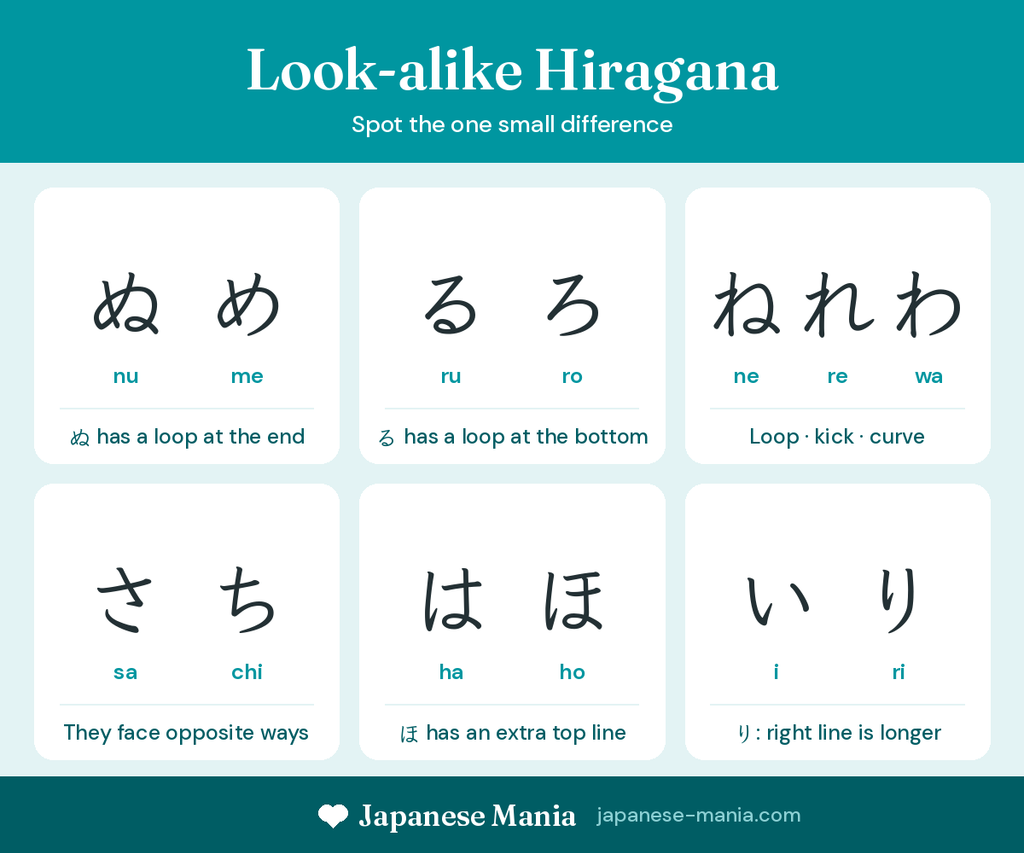
Almost every learner mixes these up at first. Look for the one small difference:
| Pair | The difference |
|---|---|
| ぬ nu / め me | ぬ has a little loop at the end. め doesn’t. |
| る ru / ろ ro | る has a loop at the bottom. ろ is open. |
| ね ne / れ re / わ wa | Look at the right side: ね ends with a loop, れ kicks up and out, わ curves back in. |
| さ sa / ち chi | They face opposite ways. さ opens to the right, ち opens to the left. |
| は ha / ほ ho | ほ has an extra horizontal line at the top. |
| い i / り ri | In り, the right line is much longer than the left one. |
Tip: practice each pair side by side, and say the sounds out loud as you write.
A simple 7-day plan
15 to 20 minutes a day is enough. Learn two rows a day, then use the last two days to review.
| Day | Characters | New |
|---|---|---|
| 1 | あ row, か row | 10 |
| 2 | さ row, た row | 10 |
| 3 | な row, は row | 10 |
| 4 | ま row, や row | 8 |
| 5 | ら row, わ, を, ん | 8 |
| 6 | Review + dakuten and handakuten (が, ぱ…) | – |
| 7 | Final review + read real words | – |
Each day, start by reviewing the characters from the day before. Short daily practice works much better than one long session.
Try it: words you already know from anime
Cover the right side and try to read these on your own.
| Hiragana | Romaji | Meaning |
|---|---|---|
| すごい | sugoi | amazing |
| かわいい | kawaii | cute |
| ありがとう | arigatou | thank you |
| せんせい | sensei | teacher |
| ともだち | tomodachi | friend |
| ねこ | neko | cat |
| おにぎり | onigiri | rice ball |
| だいすき | daisuki | I love it / I love you |
Read them out loud. Reading words you already know is the fastest way to make hiragana stick.
FAQ
How long does it take to learn hiragana? Most learners can read all 46 characters in about a week with 15 to 20 minutes of daily practice. Reading quickly takes a few more weeks of regular use.
Should I learn hiragana or katakana first? Hiragana first. It’s used much more often, and katakana is easier once you know how the chart works.
Can I just use romaji instead? Romaji is fine for your first few days, but try to stop using it soon. Textbooks, manga and signs in Japan are written in Japanese, and relying on romaji slows down your reading.
Do I really need to learn stroke order? Yes. It’s quick to learn, and it makes your handwriting clear and easier to read.
Get the free workbook: Read Hiragana in 7 Days
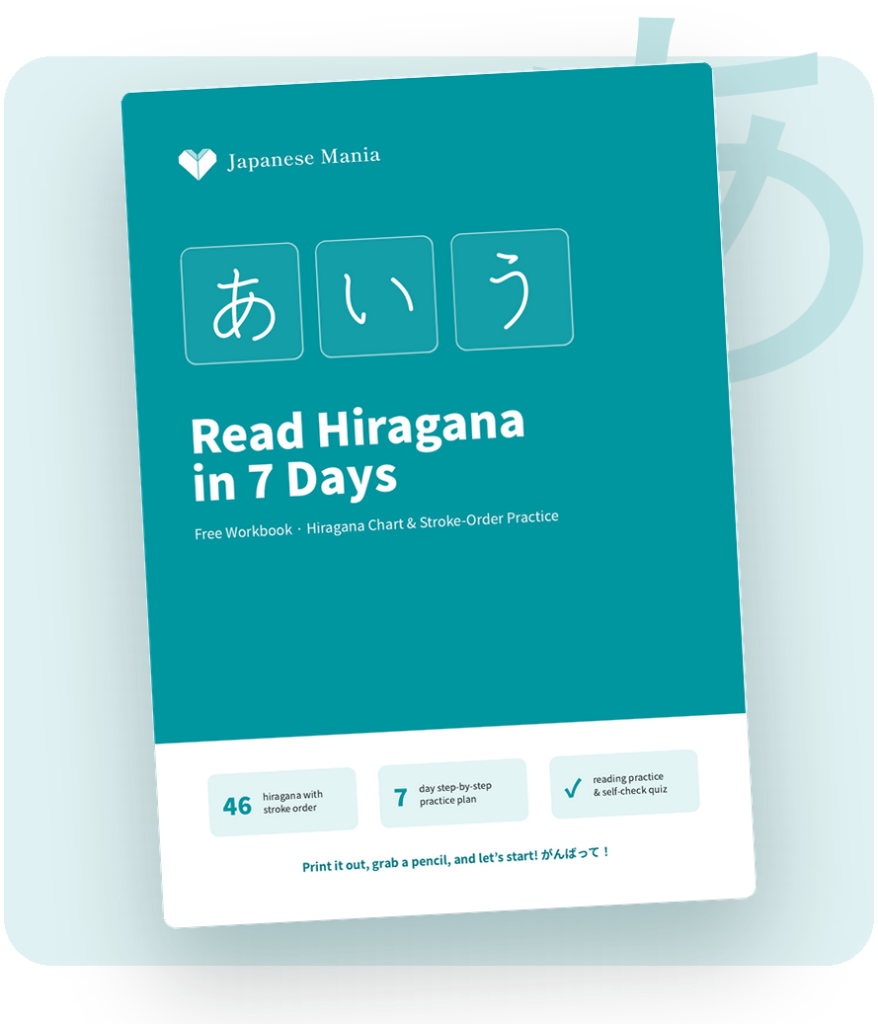
Reading a chart is a start, but writing each character by hand is what makes it stick. My free 15-page workbook gives you:
- All 46 hiragana with stroke order
- A 7-day step-by-step practice plan
- Reading practice and a self-check quiz
Print it out, grab a pencil, and let’s start! がんばって!